
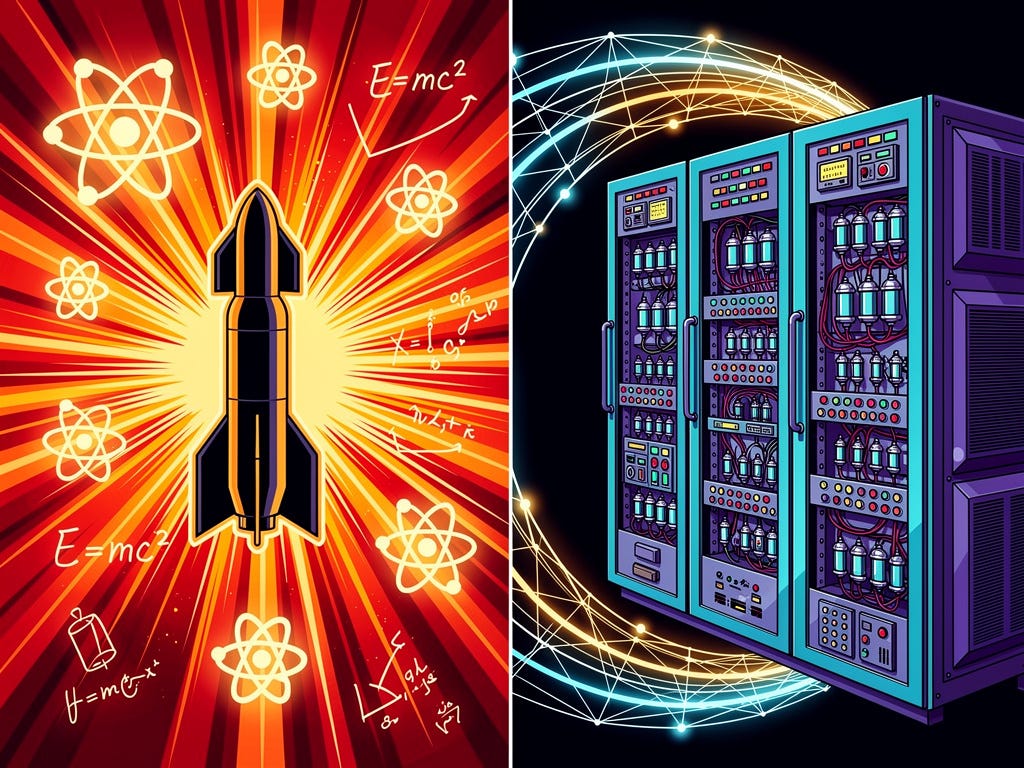
Did you know the US race to develop nuclear weapons first led to the modern Information Age? If not read on to find out how!
In 1938 three Nazi German scientists conducted a nuclear experiment. They bombarded Uranium atoms with neutrons and made an unexpected discovery: it was possible to split the nucleus of the chemical element Uranium into two smaller nuclei. Otto Hahn, Lise Meitner, and Fritz Strassman eventually realized they had discovered nuclear fission. Nuclear fission released massive energy and neutrons. The neutrons released from one atom splitting can next be used to split more atoms: a chain reaction. An unchecked chain reaction would result in a massive explosion.1
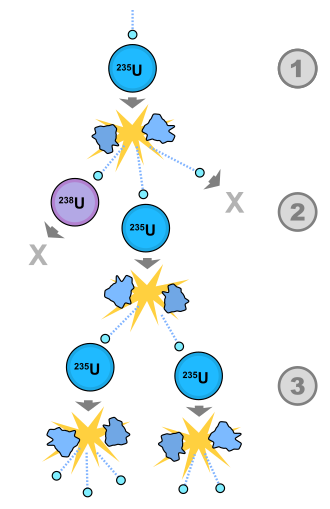
The German scientists met physicist Niels Bohr to reveal their findings. Niels Bohr rushed to pass on the findings at a scientific conference in Washington, D.C. By March 1940 researchers discovered Uranium-235 was the uranium isotope capable of delivering a fission chain reaction. Researchers next struggled to discover how a chain reaction could be made for atomic purposes. To do that enough Uranium-235 had to be collected from natural Uranium to support a self-sustaining chain reaction. The minimum amount is known as critical mass.2
It is academic tradition to freely exchange information to benefit the human race. But lead American scientists including Enrico Fermi and Edward Teller convinced the American and British scientific community to keep the Manhattan Project a secret lest Germany begin their own nuclear weapons program. After a stir of disagreement both Europe and the United States agreed to ban all public research on nuclear weapons by 1940 CE.3
Despite US and European attempts to censor atomic research news of the discovery of nuclear fission spread in Germany. Many physicists that fled Nazi Germany to te US were concerned. At first US physicists struggled to get the attention of the US Government. Leo Szilard convinced Albert Einstein to write a famous letter to US President Franklin D. Roosevelt.45
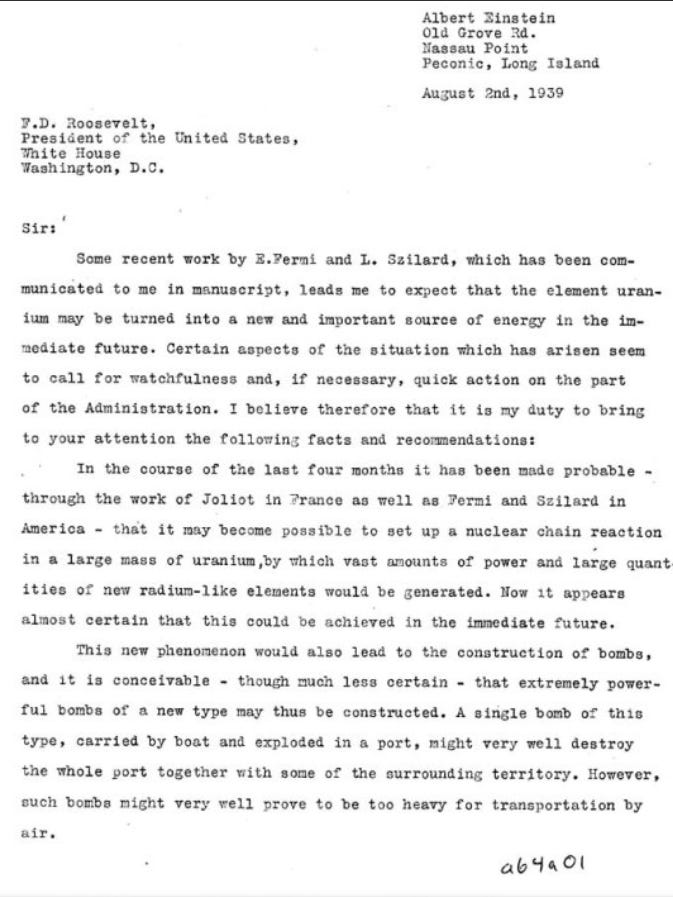
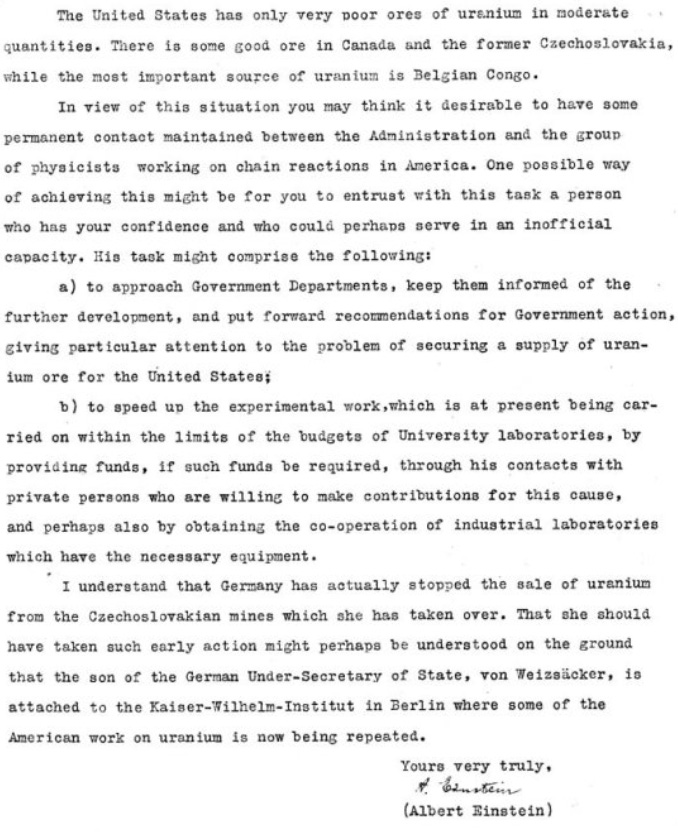
President Franklin D. Roosevelt responded by forming the Manhattan Project.6 In 1940. The world watched in terror as Nazi Germany quickly conquered other European nations. In 1941 the National Defense Research Committee led by Vannevar Bush received the MAUD Report. This famous report by the British MAUD Committee reported ten kilograms of enriched Uranium-235 would be enough to produce a nuclear bomb.7
In December 1941 the US was surprised by Japan’s attack on Pearl Harbor. President Franklin D. Roosevelt, authorized as commander-in-chief of America in World War II, authorized Vannevar Bush to oversee the creation of America’s first atomic bomb. Fueled by the fear that Germany was ahead of the US in nuclear weapons at the time (a fear that turned out to be wrong) the US raced to make the first bomb with what they felt was too little time.89
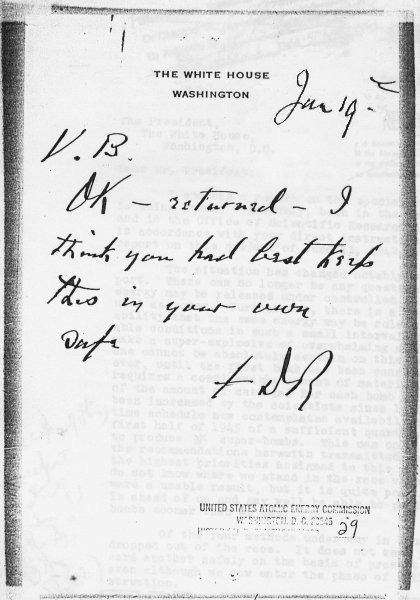
At the time Roosevelt simply wanted Bush to oversee research and development of the bomb—never for production use10. But by December 1942 the US suffered several military defeats that compelled Roosevelt to authorize the making of the first US Atomic Bomb for production use.11
The Manhattan Project in Los Alamos was formed to invent the bomb’s official design.12
The Twin Births of Modern Computing and the Atomic Bomb
In 1931 John von Neumann, a Hungarian-born mathematician, joined the Princeton University faculty.1314 Neumann would soon meet Lieutenant Herman Goldstine at the University of Pennsylvania Moore School of Electrical Engineering. Goldstine and his team were engineering a computer machine to assist the US Army’s Ballistic Research Laboratory.15 The invention of new technology to help US war efforts had an unintended side effect: it required humans to solve thousands of tedious calculations in differential equations to fire artillery.16
To assist the US Ballistic Research Laboratory with these calculations the Electronic Numerical Integrator and Computer was built by November 1945.17 The ENIAC featured Herman Hollerith’s punch-card technology standardized by IBM.18To ensure the targeted goal of 333 calculations per second von Neumann proposed the now industry-standard von Neumann Architecture. What was revolutionary about this architecture is the idea that computer programs should be stored in memory along with the computer’s data. This made the computer reprogrammable. Prior to the existence of Johnny’s design computers had to be manually rewired to change their programming—wasting countless hours. Completed too late the ENIAC was never used by the Ballistic Research Laboratory directly. Instead the ENIAC was used to speed up the development of the first hydrogen bomb.19
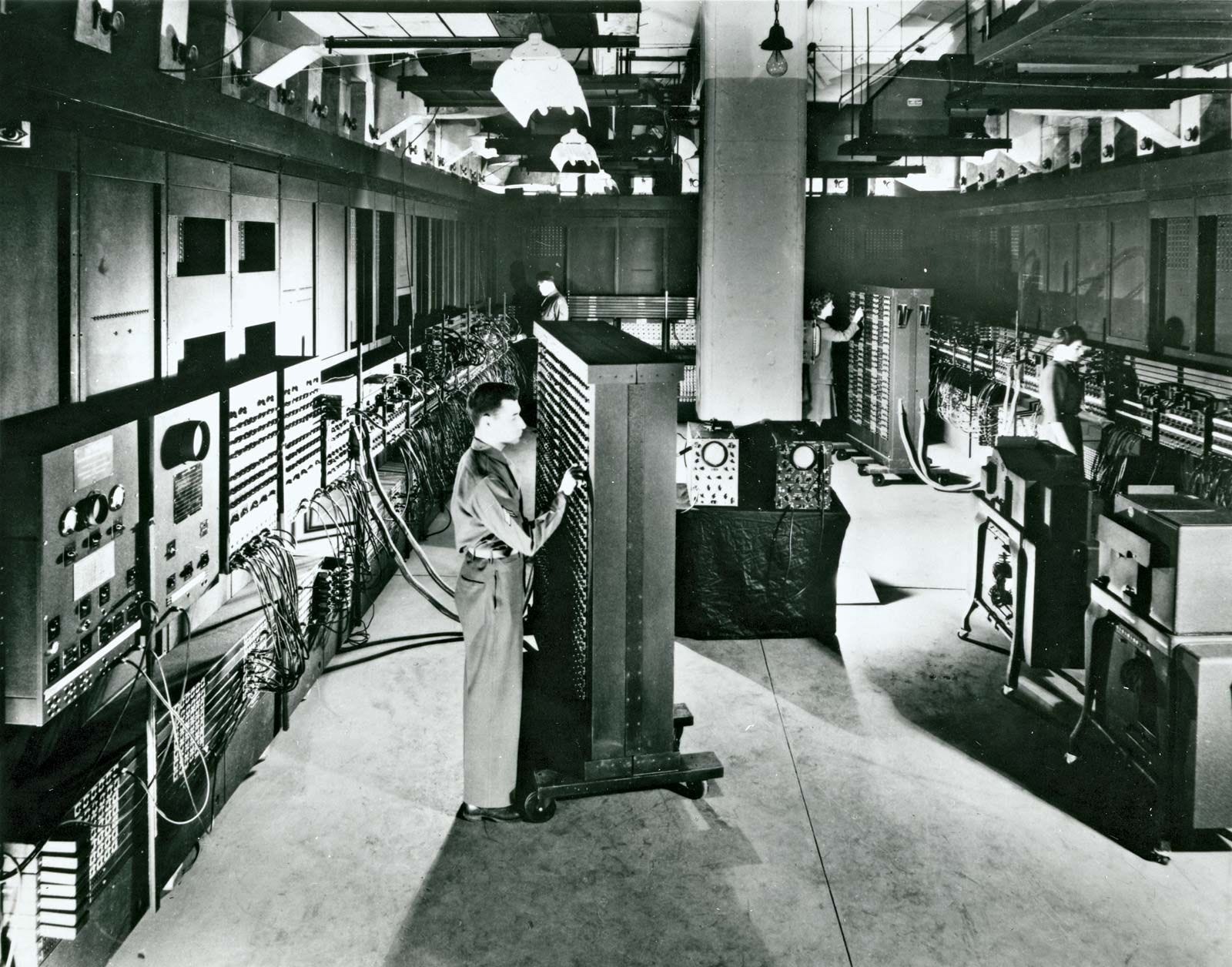
For the remainder of the 20th century the von Neumann Architecture would become the standard computer architecture first in the military, then in US Federal Government offices, the US industry, and eventually the world.20
Nuclear Espionage Births Interest in US Cybersecurity
Cybersecurity began with the US Military’s concerns of espionage targeting military secrets—the US Atomic Bomb is arguably the first documented case study of espionage in the 20th century that drove the US to later invest in computer technology such as encryption to protect such sensitive military secrets. It is obvious that the leakage of the bomb’s design posed an irrecoverable threat to US safety. As a matter of national security President Franklin D Roosevelt and other scientists tasked the US Military to keep news of the bomb a tightly-kept secret—believing this would prevent spies from Germany and Japan from stealing the bomb’s design.21
People that wanted to work for the US Government to build the bomb were first screened for family-ties to Axis-controlled areas. If so the person was rejected.22 Germany, Japan, and the USSR all made attempts to send spies to the US to steal the bomb’s design. Only the USSR succeeded. And there is a reason for that. Emigrants to the US were much more sympathetic to Communist ideologies than they were to Germany and Japan’s nationalist-pride fueled campaings. In a future blog article I will explain why emigrants would sympathize with the USSR despite the horrible crimes against humanity they committed. You must understand why such people exist. It is because of political disagreements like this that the Nuclear Age continued—giving birth to the Computer and Cybersecurity industries with them.23
For now understand hundreds of US citizens voluntarily gave away military secrets, including the design of the US Atomic Bomb, to USSR spies because of these sympathies. Even many physicists were members of the American Communist Party and shared secret information with them. The Red Scarce in the media and fictional literature is depicted as a mass hysteria comparable to other fanatical moments in history gone wrong—but the cold truth is serious evidence of espionage was brought forth during this time. In future blog articles I will clarify how that led the US to invest in Internet security.24 The US launched programs such as the National Security Agency to detect such attempts at espionage—where spies often concealed their messages using cryptography.25
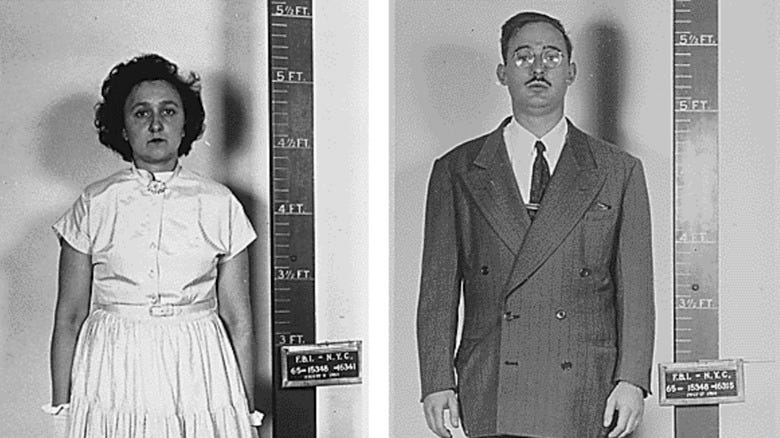
For now understand that such Communist sympathies are what allowed USSR spies such as Julius and Ethel Rosenberg to steal the secret design of the US Atomic Bomb to the USSR. For the remainder of the 20th century the world watched in terror as both the US and USSR produced nuclear weapons in mass number—ready to destroy the modern world as we know it in the flash of a second.
In the next blog article I will explain how the discover of USSR satellite Sputnik terrified the US Federal Government into birthing the modern Internet with the founding of Defense Advanced Research Projects Agency.
"The Discovery of Fission, 1938–1939." Manhattan Project: A New World, 1890s–1939, U.S. Department of Energy, Office of Scientific and Technical Information, www.osti.gov/opennet/manhattan-project-history/Events/1890s-1939/discovery_fission.htm.
“The Discovery of Fission, 1938–1939.” Manhattan Project: A New World, 1890s–1939, U.S. Department of Energy, Office of Scientific and Technical Information, www.osti.gov/opennet/manhattan-project-history/Events/1890s-1939/discovery_fission.htm.
“The Discovery of Fission, 1938–1939.” Manhattan Project: A New World, 1890s–1939, U.S. Department of Energy, Office of Scientific and Technical Information, www.osti.gov/opennet/manhattan-project-history/Events/1890s-1939/discovery_fission.htm.
“1939–1942.” Manhattan Project: A New World, 1939–1942, U.S. Department of Energy, Office of Scientific and Technical Information, www.osti.gov/opennet/manhattan-project-history/Events/1939-1942/1939-1942.htm.
“Einstein’s Letter Photograph.” Manhattan Project: A New World, U.S. Department of Energy, Office of Scientific and Technical Information, www.osti.gov/opennet/manhattan-project-history/Resources/einstein_letter_photograph.htm#1.
"1939–1942." Manhattan Project: A New World, 1939–1942, U.S. Department of Energy, Office of Scientific and Technical Information, www.osti.gov/opennet/manhattan-project-history/Events/1939-1942/1939-1942.htm.
“The MAUD Report.” Manhattan Project: A New World, 1939–1942, U.S. Department of Energy, Office of Scientific and Technical Information, www.osti.gov/opennet/manhattan-project-history/Events/1939-1942/maud.htm.
"1939–1942." Manhattan Project: A New World, 1939–1942, U.S. Department of Energy, Office of Scientific and Technical Information, www.osti.gov/opennet/manhattan-project-history/Events/1939-1942/1939-1942.htm.
“Tentative Decision to Build.” Manhattan Project: A New World, 1939–1942, U.S. Department of Energy, Office of Scientific and Technical Information, www.osti.gov/opennet/manhattan-project-history/Events/1939-1942/tentative_decision_build.htm.
“Tentative Decision to Build.” Manhattan Project: A New World, 1939–1942, U.S. Department of Energy, Office of Scientific and Technical Information, www.osti.gov/opennet/manhattan-project-history/Events/1939-1942/tentative_decision_build.htm.
"1942." Manhattan Project: A New World, U.S. Department of Energy, Office of Scientific and Technical Information, www.osti.gov/opennet/manhattan-project-history/Events/1942/1942.htm.
“1942–1945.” Manhattan Project: A New World, U.S. Department of Energy, Office of Scientific and Technical Information, www.osti.gov/opennet/manhattan-project-history/Events/1942-1945/1942-1945.htm.
Institute for Advanced Study. John von Neumann Papers. Institute for Advanced Study, [n.d.], https://library.ias.edu/von-neumann.
Budiansky, Stephen. Code Warriors: NSA’s Codebreakers and the Secret Intelligence War Against the Soviet Union. Knopf, 2016.
Budiansky, Stephen. Code Warriors: NSA’s Codebreakers and the Secret Intelligence War Against the Soviet Union. Knopf, 2016.
Martin, Dianne. "ENIAC: The Press Conference That Shook the World." IEEE Annals of the History of Computing, vol. 12, no. 4, 1990, pp. 42-51.
Martin, Dianne. “ENIAC: The Press Conference That Shook the World.” IEEE Annals of the History of Computing, vol. 12, no. 4, 1990, pp. 42-51.
“Punched Cards.” Department of Electrical and Systems Engineering, University of Pennsylvania, www.seas.upenn.edu/~pws/EMX/punch.html.
Budiansky, Stephen. Code Warriors: NSA’s Codebreakers and the Secret Intelligence War Against the Soviet Union. Knopf, 2016.
Computers in Government: We Couldn’t Do Without Them. U.S. Government Accountability Office, 1 June 1980, www.gao.gov/products/112745.
“Counterintelligence Corps (CIC).” Manhattan Project: A New World, U.S. Department of Energy, Office of Scientific and Technical Information, www.osti.gov/opennet/manhattan-project-history/People/MilitaryOrgs/cic.html.
“Counterintelligence Corps (CIC).” Manhattan Project: A New World, U.S. Department of Energy, Office of Scientific and Technical Information, www.osti.gov/opennet/manhattan-project-history/People/MilitaryOrgs/cic.html.
“Espionage.” Manhattan Project: A New World, 1942–1945, U.S. Department of Energy, Office of Scientific and Technical Information, www.osti.gov/opennet/manhattan-project-history/Events/1942-1945/espionage.htm.
Haynes, John Earl, and Harvey Klehr. Venona: Decoding Soviet Espionage in America. Yale University Press, 1999.
Bamford, James. The Puzzle Palace: A Report on America’s Most Secret Agency. Houghton Mifflin, 1982.