
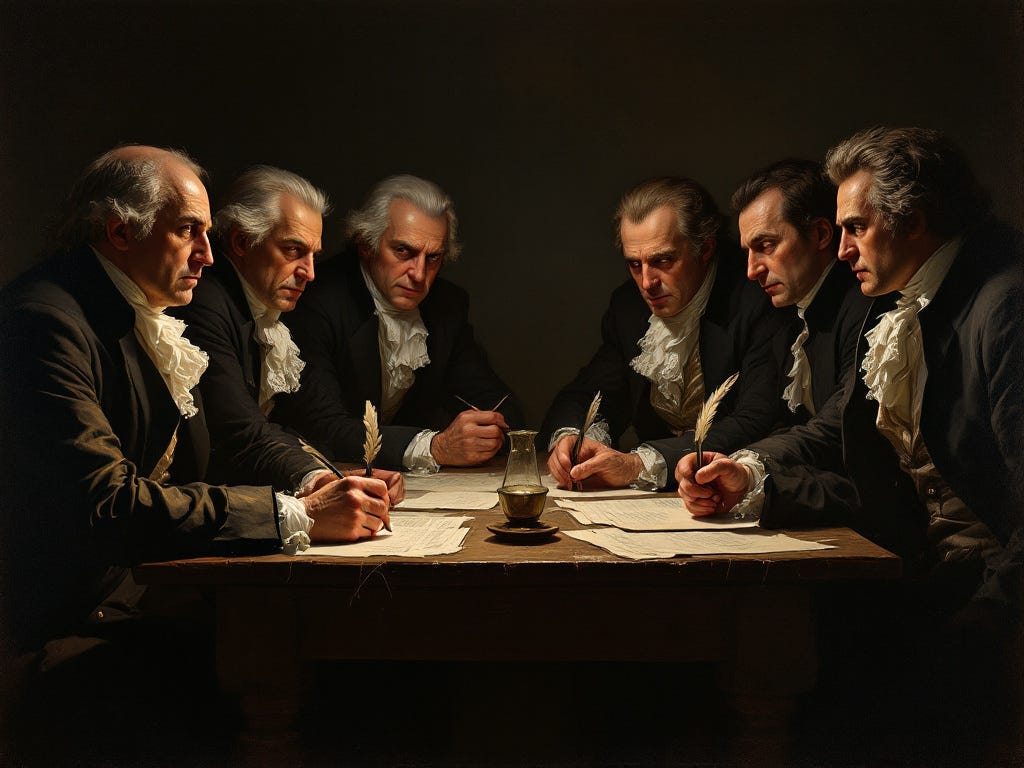
James Madison was the leading author of the US Constitution. Madison listened to the concerns of Anti-Federalists’ on the lack of protections against general warrants in the US Constitution. That’s one of the reasons why the Anti-Federalists argued for the existence of a bill of rights. To demonstrate their case the Anti-Federalists cited several clauses from the US Constitution to invite abuse of power: the Constitution allowed the national government to “promote the general Welfare” and to enact “necessary and proper” laws that are the “supreme law of the land”. The problem with these clauses is that the US Government would be able to make up excuses to abuse their power to “promote the general Welfare” claiming unethical laws were “necessary and proper”.
James Madison claimed that was a valid complaint. Madison admitted the Constitution gave Congress powers and the ability to make up policies to raise their own powers. For the case of unreasonable searches and seizures Madison admitted Congress could therefore enact general warrants to enforce taxation—a lesson Madison must have learnt from the Wilkes Affair in Great Britain. Madison concluded the banning of such general warrants to state agents by state constitutions demonstrates a corresponding need for a ban at the federal level.
Ironically the US House of Representatives ignored Madison’s pleas for a restriction against general warrants twice. So Madison reintroduced them with the help of Elbridge Gerry on 21 July, requesting a committee of the whole house debate the manner. Unfortunately even that did not work. A counterproposal made my Fisher Ames of Massachusetts convinced Congress Madison’s proposal was not too important. Instead the US House of Representatives deflected Madison’s amendments to a select “Committee of Eleven” that featured one representative from each state. Unfortunately Vining’s Committee reasoned people only had the right to be secure in their persons, houses, papers, and effects against warrants that had been issued without probable cause or oath. The Vining Committee’s edit of the Fourth Amendment proposal did not guarantee protection against specific persons, palaces, or things.
Madison next put in an intense amount of effort again a third time in a row—and thankfully consideration resumed on 13 August. This time the US House of Representatives made four revisions in the search and seizure that the Committee of Eleven had reported. Ironically although Madison was a Federalist and therefore was politically against the Anti-Federalists these events demonstrate he truly cared about protecting people from relentless invasions of their personal lives. Egbert Benson of New York was the man who reinserted the phrase “unreasonable searches and seizure”. Because of Madison and Benson the final fourth amendment had the phrase: “the right of the people to be secure in their persons, houses, papers, and effects against unreasonable searches and seizures”.
Madison originally wanted the Bill of Rights to be an integral part of the US Constitution. However Roger Sherman of Connecticut insisted the entire Bill of Rigths exist as a separate appendix. By 25 September 1789 we see the Fourth Amendment in its final form:
The right of the people to be secure in their persons, houses, papers, and effects
against unreasonable searches and seizures, shall not be violated, and no warrants
shall issue but upon probable cause, supported by oath or affirmation, and particu-
larly describing the place to be searched and the persons or things to be seized.
The Politics of the Fourth Amendment
James Madison and the other Federalists did not help pass the Fourth Amendment purely out of the goodness of their hearts. They were private political reasons they had.
The insistence of the inclusion of a right against unreasonable search and seizure by the Virginia Convention was a compromise combining both Federalist and Anti-Federalist features. Indeed a key strategy the people that built this country exercised to ensure its unity was compromise—even illogical ones such as the Three-Fifths Compromise as long as it avoided civil unrest.
Madison claimed his amendments as a gracious concession to a defeated minority (The Anti-Federalists) with sincere but groundless fears of endangered liberties. Unfortunately by June 8, 1789 his political opponents still didn’t trust him or The Federalists.
Virginians rejected Madison for the federal senate and to add insult to injury elected Anti-Federalist Richard Henry Lee instead. Leading Anti-Federalist Patrick Henry even tried to keep Madison out of the House of Representatives but that failed. Anti-Feederalists and legislatures were so distrusting they even had plans for a second Constitutional Convention to weaken the US Constitution.
Madison thus was lucky that he did not reveal the real reason for the Fourth Amendment: the Fourth Amendment was made to ensure the US Constiution was ratified, not as a gratuity. Just remember the Anti-Federalists and the states that refused to acknowledge the US Constitution played a big role in Madison going that four to ensure the Amendments were included and approved by the US House of Representatives. Madison, in secret, admitted the Bill of Rights was made to ensure the US Constitution’s survival. Madison needed to ensure he was elected as a member of Congress and he had to exercise a commitment to amendments.
So the bitter truth is The Bill of Rights was made to weaken the Anti-Federalists and ensure the growth and public support of the Federalists.
Not because the Federalists really cared about protecting people from unreasonable search and seizures.
Madison planned The Bill of Rights to weaken all opposition to the US Constitution’s ratification. Madison was concerned without strong federal rights the US Federal Government would have no power to tax, conduct military operations, and regulate commerce. In the next article I will talk more on how Madison intended to split the Anti-Federalists with the creation of the Bill of Rights.