
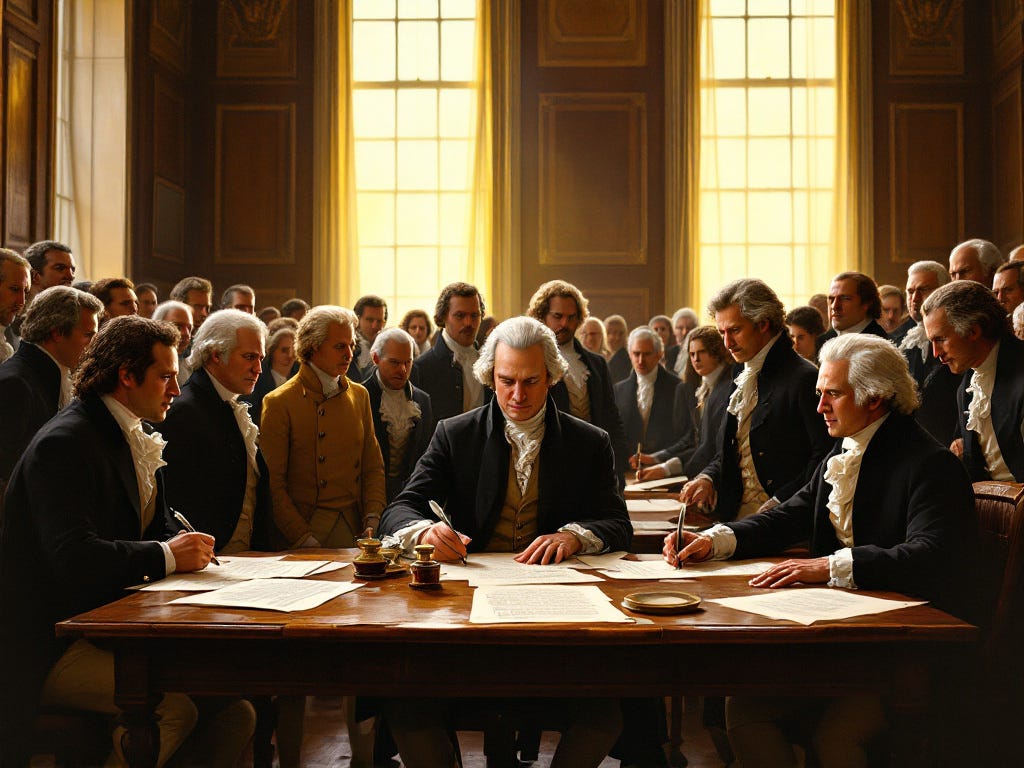
As the subtitle points out The Federalists, especially James Madison, urged the US House of Representatives to pass the Bill of Rights. At face-value Madison claimed it was out of the good-will of the people. In reality it was meant to weaken The Anti-Federalist party.
Here is how that worked. The Anti-Federalists that actually cared about those rights would applaud The Bill of Rights. Those who secretly claimed to care but in reality wanted to weaken the Constitution would be ostracized for publicly rejecting them. William J Cuddihy, writer of The Fourth Amendment: Origins and Original Meaning, admits this is the true intent of The Bill of Rights. Not to protect people from search, seizure, and other government activities.
Thomas Jefferson was another founder who argued for the existence of The Bill of Rights. In the Virginia Convention of 1788 Madison at first argued there was no need for a federal bill of rights since state protections were sufficient. Jefferson argued some level of federal protection was better than none since state governments were weaker than federal governments. Madison found this reasonable and used his argument in front of Congress.
Madison’s plan to alienate The Anti-Federalists succeeded spectacularly. The Anti-Federalist campaign to reject the Bill of Rights failed miserably.
Despite this massive victory there is unfortunately very little commentary on the ratification of the Bill of Rights aside from Virginia. Yet the fourteen state legislatures that approved of the last ten of the original twelve bill of rights only left behind journals of the debates that led to this event. None of them have any comments on the Fourth Amendment. This makes it clear that state legislatures were overall satisfied with The Bill of Rights as presented and were not interested in any further major adjustments to the US Constitution. Unsurprisingly Massachusetts, the colony that led the resistance against general warrants, refused to adopt the Bill of Rights. The Anti-Federalists had an exceptionally strong influence there. Ironically, some of the loudest complainers in favor of The Fourth Amendment were those that themselves conducted unreasonable searches and seizures. They were concerned about the federal misuse of power threatening their own private political interests. The strongest call to the right therefore came from the states that had least observed it.
The ultimate case-study of this is Samuel Adams. Samuel used to be one of the strongest dissidents against the unreasonable search and seizure—a title he held by 1788. Adams realized The Federalists invented The Bill of Rights to weaken the Anti-Federalists. To everyone’s shock in the Massachusetts Convention of 1788 Samuel Adams finally abandoned the right against unreasonable search and seizure after being a hero of its defense for five decades. It is clear political self-interest is a must to understand the Bill of Rights.
Only truly few never deviated from hostility to it—despite the turbulence of 1787-9. George Bryan and Robert Whitehill of Pennsylvania repudiated such general warrants from the state to federal level even when the Constitutionalist political party was responsible for issuing them. Although Madison was politically motivated to weaken the Anti-Federalists in designing the Fourth Amendment Madison wanted the Fourth Amendment to restrain the right against unreasonable search and seizure conducted by the potential majority in power. And in a democracy the majority in power would channel popular consent for oppressing the minority.
Since even the Federalists considered federal protection against unreasonable searches to be weak other measures were taken. Alexander Hamilton, a fellow Federalist, helped pass the Excise Acts of 1791 to fine officers that abused their power to search and seize. The burden of proof rested on the officer. Failure to do so in a lawsuit would result in hefty fines and imprisonment. A much stronger privacy law code than the Fourth Amendment is the General Data Protection Regulation—which is the strongest privacy protection in the world.
The Fourth Amendment itself does not define what “unreasonable” and “probable cause” means—leaving them vulnerable to perversion. It does not categorize searches or seizures as reasonable or unreasonable nor does it reveal when warrants are required. The framers of the Fourth Amendment paid less attention to the surveillance and intrusion that arrest warrants and other devices of search and seizure permit. The Amendment also fails to define probable cause. This was partly done to prevent controversy. The framers of the amendment defined search warrants more than others to avoid arguments when ratification of the amendment was considered. The downside to this is that the Fourth Amendment is an arguably weak protection versus stronger privacy laws such as GDPR.
Strangely, William J Cuddihy writes in his book that even after centuries the concept of probable cause, arrest warrants, and warrantless seizures had never occasioned the intensity or depth of thought, adjudication, and legislation that search warrants had. As I said in past newsletters the Fourth Amendment only really succeeded in preventing the US Federal Governments from issuing general warrants.