
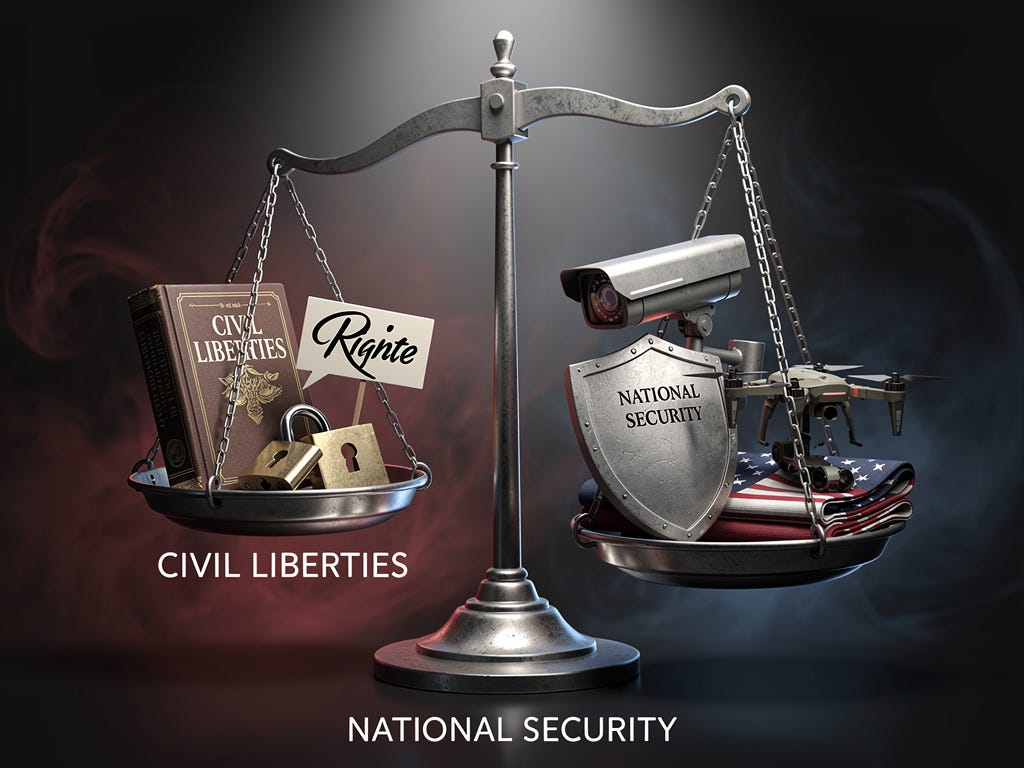
William Rehnquist, Chief Justice of the US Supreme Court, has said: “It is neither desirable nor is it remotely likely that civil liberty will occupy as favored a position in wartime as it does in peactime”.
Rehnquist’s saying should come across as a warning. Real people that manage the US Government truly believe such a tradeoff is worth it. Go back and read that sentence again. In an earlier article I mentioned mentality like this is how tyrants gain power.
As Daniel J Solove in his book Nothing to Hide points out—in the worst of times of crisis we should be at our literal best to protect our civil liberties.
Instead, most Americans seem to agree with Rehnquist. In a poll shortly after the 9/11 attacks 68% of US Citizens agreed they would be willing to give up their civil liberties! In early 2002, about 78% said they are “more willing to give up certain freedoms to improve safety and security”. With this herd mentality most are willing to forfeit the civil liberties of others to save their own skin.
There were several cases where civil liberties were suspended. And you will be surprised who in the US Government has authorized them. US President Abraham Lincoln infamously suspended habeus corpeus, the right of a person to a trial by jury for unlawful imprisonment. People that criticized the US’s involvement in World War I were prosecuted—a violation of the First Amendment. In World War II, the US Government imprisoned over 120,000 Japanese citizens into internment camps. In the Red Scare, hundreds of people were unfairly spied on, interrogated, and had their lives ruined. Many lost their jobs and banned from employment for years.
The US Legal system has done little to protect people from such mistreatment in the past. US Supreme Court upheld the ban against criticism of the US’s involvement in World War I. In the past it has upheld the decision to imprison Japanese citizens. Today US Supreme Court is far more tolerant of criticism against US Wars. Thousands of people were imprisoned without trial—barred from access to the outside world after the events of 9/11. Today we are dealing with the imprisonment of immigrants under US Immigrations and Customs Enforcement.
Thoughout history what the US Government did in response to public outcries is apologize. But then again as Solove points out they didn’t learn from their mistakes.
Not only do people in the US Government think its okay to forfeit people’s civil liberties in times of crisis—they also think its okay to lessen checks and balances on government behavior on matters of national security. Such people often think its okay to weaken Fourth Amendment protections, which are already weak compared to other global standards, or consider them non applicable in times of national security in the first place.
To illustrate why such thinking is a terrible idea Solove in his book gives case studies demonstrating the distinction between regular crime and national security are two esoteric to be made clear.
Consider the case of a bomb incident in the US. How would one classify that as a national security threat. One intuition is to count the number of victims. However under that principle even a serial killer that travels on the highway can count as a national security threat. Solove says a second intuitive way is by means of attack. But even in a system like that there are too many false alarms. A lot of them come from disgruntled employees.
Sometimes people act crazy in a way that is hard to predict. A real person flew an airplane into an IRS building since he was against federal income tax.
So the real issue with classifying national security threats compared to normal crime. There are rules restricting what governments can do for ordinary crime to protect innocent people from harm during an investigation.
Since it is hard to define what a “national security” concern is. As such President Administrations such as the Nixon Administration got away with spying on others they did not like (WaterGate Scandal).
Instead of protecting the United States national security instead has been abused in name to increase the executive branch’s powers and decrease their public accountability.
The Rise of FISA
In 1978, the Foreign Intelligene Surveillance Act was passed. It allows governments to collect foreign intelligence within US borders. The surveillance is peer-reviewed by a court of eleven judges known as the Foreign Intelligence Surveillance Court. Anyone deemed a “foreign power” (broadly defined) can be a target of surveillance under FISA. A FISA order for surveillance is under much less judicial oversight than a normal court case. A surveillance investigation can last three to four times more under FISA than under the Electronic Communications Privacy Act. In the next article I will explain more about FISA and its issues.