
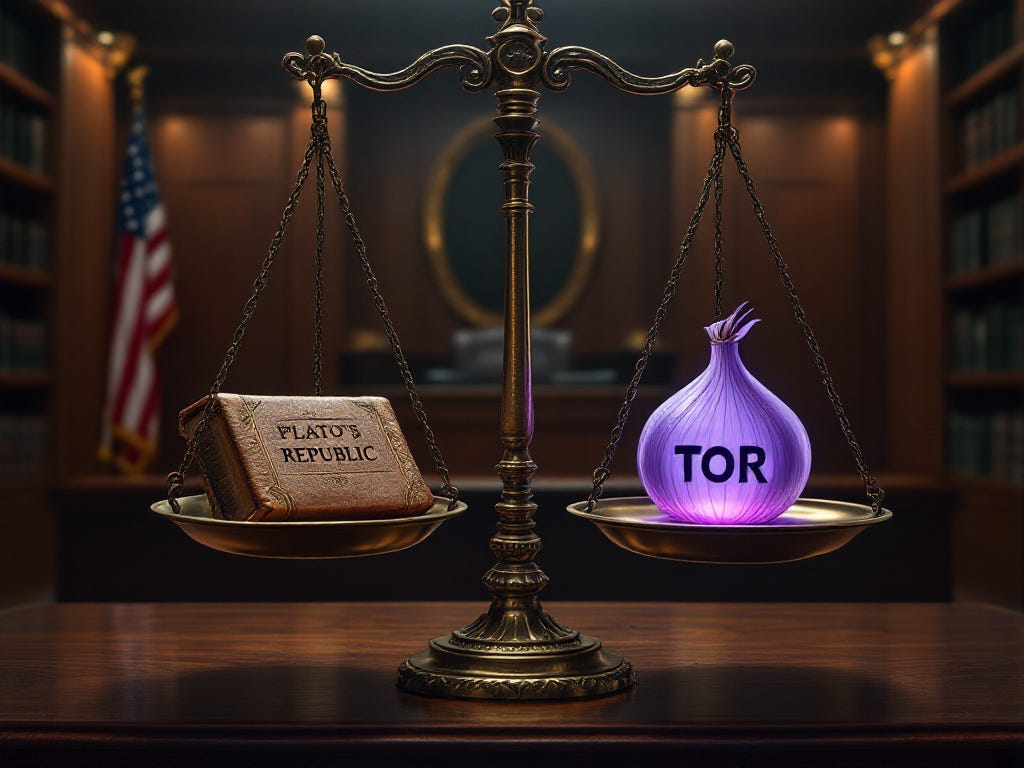
Throughout this article series I have identified three critical agents in protecting our privacy:
The Press: Without them the public would be unaware of abuse of surveillance.
The Judicial Branch: Without them people would be able to get away with ignoring interpretations of the law.
The Legal Branch: Without them there would be no written restrictions on how organizations conduct surveillance.
But I am here to tell you I discovered an unexpected fourth: the academic community.
U.S. courts have a strong preference for technological experts from the academic community rather than the industry. According to the Federal Judicial Center US judges believe the industry is much more susceptible to financial conflicts of interest than academia is. Consider that academia is more transparent in its intellectual exchange of information. This drives judges to believe they satisfy the following four criterion:
Testifiability or Falsifiability
Peer Review
A known or potential error rate
General Acceptance of Scientific Claim in Scientific Community
US Supreme Court has determined these as the criterion of court-viable scientific knowledge.
It is thus no accident that US Supreme Courts have a strong preference for members of the academic community to serve as technological experts in court cases involving digital surveillance. The following are a list of people that have strong academic credentials that have served as technical experts in court cases:
Bruce Schneier: Lecturer at Harvard Kennedy School
Susan Landau: Professor of Cyber Security and Policy at Tufts University
Matt Blaze: Professor at University of Pennsylvania
Edward Felten: Professor of Computer Science and Public Affairs, Emeritus, Princeton University
Other than professors of computer science sometimes professors of law that have training in digital forensics are also asked to serve courts for their technical expertise.
This is not to say people with pure industry experience are never considered to serve courts for their technical expertise. Still even such experts must build credibility by publishing peer-reviewed technical research that showcases their expertise to the public.
Why Did I Not Mention Inventors of Privacy Gadgets
I decided not to mention any privacy gadgets for a simple reason: they provide a false sense of security. If you are reading this you may be using one of the “privacy” gadgets including but not limited: ProtonMail, Tuta, TOR, and Signal. Such technologies have been endorsed by privacy-respecting organizations such as the Electronic Frontier Foundation—which has received support from venerable people including Edward Snowden—the man who leaked the NSA records to the public. For example let me start with TOR: no it does not guarantee your anonymity against government surveillance. And the failure of Ross Ulbricht proves TOR is not invincible to powerful governments.
TOR Fails to Protect Ross Ulbricht

Like many Ross Ulbricht believed TOR made him anonymous against government surveillance. With saying Ulbricht had no issue of running an illegal dark market known as the Silk Road: an online marketplace to sell drugs. Unfortunately for Ulbricht his overconfidence got the best of him.
In March 2013 the Silk Road faced several attacks crashing the Tor servers that allowed it to remain live on the network. That leaked Ross Ulbricht’s true IP address. And that alone would allow law enforcement to hunt down where Ross Ulbricht lived. Ulbricht really should have shut down his servers and moved to another location while he could. Instead he kept hosting the site. Fatal mistake.
Atlantis later called Ulbricht and admitted they no longer believed Tor to be secure after major holes were discovered and asked him to do the same. Ulbricht did not listen. He was arrested on September 30, 2013.
During trial the FBI and Department of Health and Services revealed they attacked TOR from the very beginning. A Department of Health and Services agent even overtook a Silk Road administrator account and received $1,000 USD in Bitcoins per week as payment! One of Ulbricht’s top lieutenants was a federal agent the entire time! However federal agents in court revealed the leakage of Ulbricht’s IP address allowed authorities to find him at a library and arrest him.
In 2014 and 2015 the FBI, DHS, and European law enforcement teamed up to take down several illegal dark markets.
Creator of TOR Gets Furious
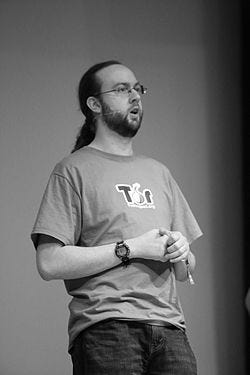
Roger Dingledine, the creator of TOR, angrily accused Carnegie Mellon researchers for assisting the US Government to hunt down criminals:
The Tor Project has learned more about last year’s attack by Carnegie Mellon Researchers on the hidden subservice system. Apparently these researchers were paid by the FBI to attack hidden services users in a broad sweep, and then sift through their data to find people whom they could accuse of crimes” — Roger Dingledine, 2005
The fact that Dingledine had to call out researchers for not obeying ethical codes implies TOR is not as anonymous from government surveillance as one would like to think.
Edward Snowden, the whisteblower that leaked NSA top-secret documents to the world, is also a huge advocate of TOR. Yet ironically, even the NSA documents he leaked point out the NSA is able to de-anonymize at least a small fraction of TOR users.1
One of the best books that documents the secret miliary history and alliance of tech companies with the federal government and its digital surveillance programs is Surveillance Valley: The Secret Military History of the Internet by Yasha Levine. This book truly has opened my eyes to how intrusive the US Federal Government has become in spying on our personal lives. The surveillance tactics the government exercises will make one more sympathetic to Edward Snowden and why he leaked his documents: digital surveillance is a serious threat to our First, Fourth, and Fifth Amendments.
For the rest of this article I will be citing Levine’s great book.
In fact the NSA began working on cracking TOR since the year Dingledine signed the military contract to fund TOR! Turns out the NSA has been spying on members of Al Qaeda using TOR.
No Signal Will Not Save You Either
Even Signal is vulnerable to government surveillance. Edward Snowden’s leaks point out the NSA can simply send all information on people’s phones to the NSA. That would include all text messages people send through Signal. It really does not matter if Signal is “end-to-end encrypted” if there is malware in your device that keylogs everything you type to an attacker.
This was confirmed to be the case in a 2007 Wikileaks report. Both the CIA and NSA worked together to develop keylogger tools.2 The tools would report the phone user’s geolocation, audio, and text communications.
This is why in 2016 protestors of the Democratic National Convention were surprised to find that the police were able to figure out where they were despite using Signal. Every time your phone communicates with Signal its obvious to law enforcement who is using and who is not!
With saying in his book Levine concludes privacy technologies like Tor and Signal provide a false sense of security.
Levine concludes the only real way to resolve this is to convince the people in power to discontinue such behavior. That’s not a problem that can solved with any software. That takes political and democratic action to resolve as citizens of the republic. We must learn to team up with the correct organizations that are dedicated to this. I am researching suitable organizations and will in the future let you know what I find.
“Tor Stinks: NSA Presentation Document.” The Guardian, 4 Oct. 2013, www.theguardian.com/world/interactive/2013/oct/04/tor-stinks-nsa-presentation-document.
“Vault 7: CIA Hacking Tools Revealed,” Wikileaks, March 7, 2017, https://wikileaks.org/ciav7p1.