
One day in a class on Genetic Engineering at UCLA my professor asked us to write the following down: the reason college education gets more expensive the bureaucracy gets bigger and bigger. Professor Jiang Xueqin, a Youtuber, that went to Yale—complained about the misplaced prestige these universities get—and how unjustly expensive they are.
As it turns out colleges are little better than greedy companies—they charge high prices for tuition and invest it in everything else besides improving the student’s critical thinking skills. Even in Jefferson’s time the University of Virginia over-invested in building fancy buildings (even though Jefferson knew students would suffer in the intense heat from the material) and lavish meals—believing that would convince students to come to the university.1 This is what we still see today—elite universities continue to improve the university’s appearance at the price of raising the student’s tuition. If you are reading this you probably despised the college experience—overcrowded schools with disinterested professors and the stunning price tag of close to $100,000 for the entire tuition.
Throughout US History there has been a struggle to provide education that gives an equal and fair opportunity to everyone. I will now narrate the history of the rise of US public education and its sharp decline beginning in 1981.
Again, during Jefferson’s lifetime the situation was no different—at one point the tuition for University of Virginia became so high only the wealthiest of the elite bothered attending. Meanwhile other bright kids attended university in other states.2
Before 1837 most schools were run locally—addressing the needs of the community. Starting with Horace Mann this began to change. Governments and businesses designed public school systems throughout the US to have several qualities3:
Train workers for corporations. Leading corporations including Ford Motors, Standard Oil, and Carnegie Steel Company funded schools so they can hire workers later. This did boost the economy—however it did emerge a culture of uniformity and obedience in children. This is what every hiring manager wants: workers that can read manuals, perform simple calculations, and follow directions. The grading system, modeled after the Prussian school system, is designed to distinguish people that are best at this. Just as the original Prussian education system was designed to make obedient citizens to the Prussian military government—so did corporations want obedient workers.
Horace Mann wanted schools to filled with students from different cultures, religions, and customs. This would teach young students to respect everyone equally regardless of their background. This was arguably the best aspect of the standardized public school system—whose effect is still enjoyed to this day.
However Mann was still biased towards Protestant values—believing that instiling a Protestant work ethic was best to promote the nation’s growth.
The downsides, as the article I cited points out, are known to every student:
There is little room for personalized learning.
They do not allow for a flourishing exchange of ideas or innovations
Although both cause people to not be innovators they give what corporations want: workers that produce reliable, reproducible results.
Mann’s reforms alone did not fully solve the issue of allowing access to public education. Prior to 1862 higher education was inaccessible to the rural and working class. College already was very expensive by Jefferson’s time in the first place!
US President Abraham Lincoln signed the Morrill Act. This important act allowed US states to use royalties they received from the US Federal Government to fund the development of universities specializing in the applied sciences. It was through this act that crucial universities were formed including, but not limited to, Massachusetts Institue of Technology, Cornell University, and Brown University. Later this act was improved in the Morill Act of 1890 to require states to fund the development of universities for African Americans. Researchers including Isaac Ehrlich, Adam Cook, and Yong Yin conclude the Morill Act played a crucial role in the United States’s development as an economic superpower.4
The Morill Acts certainly did. And they were not the only cases where the US Federal Government invested in public education that made this happen.
The next major event to improve public education in the US was US Reconstruction after the US Civil War. Before the US Civil War the only Southern children to receive an education were the ones who could pay for it. Reconstruction required Southern states to fund for US public education although this was initially only allowed in the South to whites. For the first time under federal law people that used to not have access to education—African Americans, the poor, the disabled—were allowed to have an education.5
However white Southerners made intense efforts to resist allowing African Americans within the Jim Crow era. Organizations such as the NAACP worked for decades to make the case that segregated schools were hurtful to education—an argument that won in US Brown vs Board of Education. Even after Brown vs Board of Education only 2.3% of the nearly 3-million former Confederate States attended racially integrated schools. It took US Court Case Green v. County School Board of New Kent County to ensure African Americans could safely enroll in public schools. By 1970 90% of African American children in the South attended integrated schools. Unfortunately this would only last a decade thanks to Supreme Court.
There were two more legal bills that boosted US public education. The GI Bill of Rights was passed in 1944 to help US WWII veterans readjust to civilian life—including funds for education, government-backed loans, unemployment benefits, and help with finding jobs. The GI Bill made higher education accessible to veterans—allowing the rapid expansion of colleges and universities. The GI Bill helped veterans emerge from a potential life of poverty into the middle class.
US public education reached its peak when US President Lyndon B Johnson passed the Higher Education Act of 1965—offering federal grants (e.g. The Pell Grant) and low-interest loans to college students, gave federal funding to US colleges, and founded the National Teachers Corps. Lyndon B Johnson stressed the importance of such actions to provide opportunities for low-income and middle-income families, supporting struggling colleges, and improving access to literature at higher education institutions. In 2015 the National Education Association praised the program for making a college education affordable to low and middle-income Americans.6
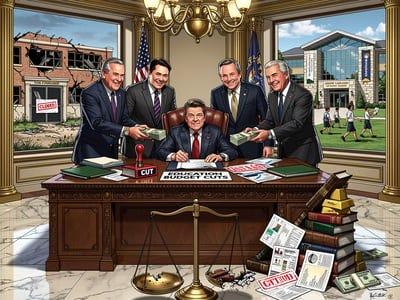
Unfortunately, as early as 1967 US public education began to decline. Then Governor of California Ronald Reagan argued integration in public schools was just as bad as segregated schools. Reagan7. Ronald Reagan campaigned to end free tuition for colleges, reduced funding for the construction of state campuses, fired Clark Kerr—the respected President of the University of California, and declared that US states are not responsible for “subsidizing intellectual curiousity”. Reagan denied additional funding even for basic education.8
US school students still suffer from the downsides of these budget cuts to this day. Students suffer from overcrowded classrooms (this hits hard to college students) that lack individual attention. Outdated textbooks. Worn-out buildings. Tired teachers. Half of LAUSD students in 1970 went on strike from lack of funding. Reagan continued cutting funds for US public education as President. Reagan cut federal funds from local school districts throughout the US and transferred them to state governments. It is clear Ronald Reagan has helped made US public educaiton significantly worse than what it was when he began his presidency. He succeeded for the same reason Jefferson failed: wealthy businessmen found no reason to support the well-being of others through public education. Thankfully, Reagan’s attempts to get rid of the US Department of Education and to reduce bilingual education failed. Still, by the end of Reagan’s presidency US Federal Budgets for education was down to 6%.9
The US professor I cited for sources 8 and 9 (the same source) is an Emeritus Professor of Education at La Salle University since 1969 CE—so he lived to see the effects of Reagan’s budget cuts first-hand in both California as Governor and once again as President.
US college education continues to grow more expensive and worse as we speak. It is my fear we will once again return to the earlier days of American education where the only wealthy families can afford education—barring the middle class and poor from receiving it. Once education becomes the sole intellectual property of the rich people will leave the United States and look for economic opportunities elsewhere as young students left Virginia to seek affordable education elsewhere.
Taylor, Alan. Thomas Jefferson’s Education. W.W. Norton & Company, 2019, pp. 211-214.
Taylor, Alan. Thomas Jefferson’s Education. W.W. Norton & Company, 2019, pp. 214.
“Horace Mann, Prussia, and Military Occupation of the Mind.” The Military-Industrial History of American Public Education, Renegade Educator, 2 Feb. 2023, renegadeeducator.com/the-military-industrial-history-of-american-public-education/.
Clinger, James C. "July 2, 1862: President Abraham Lincoln Signs the Morrill Act Establishing Land Grant Colleges." Constituting America, 2020, constitutingamerica.org/july-2-1862-president-abraham-lincoln-signs-morrill-act-establishing-land-grant-colleges-guest-essayist-james-c-clinger/ (accessed 2 Apr. 2026).
MILA. “Honoring Reconstruction’s Legacy: Educating the South’s Children.” Facing South, 10 Oct. 2018, www.facingsouth.org/2018/10/honoring-reconstructions-legacy-educating-souths-children (accessed 2 Apr. 2026).
“Higher Education Act of 1965 (HEA).” Investopedia, 23 Mar. 2026, www.investopedia.com/terms/h/higher-education-act-of-1965-hea.asp. Accessed 3 Apr. 2026.
MILA. “Honoring Reconstruction’s Legacy: Educating the South’s Children.” Facing South, 10 Oct. 2018, www.facingsouth.org/2018/10/honoring-reconstructions-legacy-educating-souths-children (accessed 2 Apr. 2026).
Clabaugh, Gary K. “The Cutting Edge: The Educational Legacy of Ronald Reagan.” ERIC, ERIC Clearinghouse on Educational Management, 2000, https://files.eric.ed.gov/fulltext/EJ684842.pdf.
Clabaugh, Gary K. “The Cutting Edge: The Educational Legacy of Ronald Reagan.” ERIC, ERIC Clearinghouse on Educational Management, 2000, https://files.eric.ed.gov/fulltext/EJ684842.pdf.