
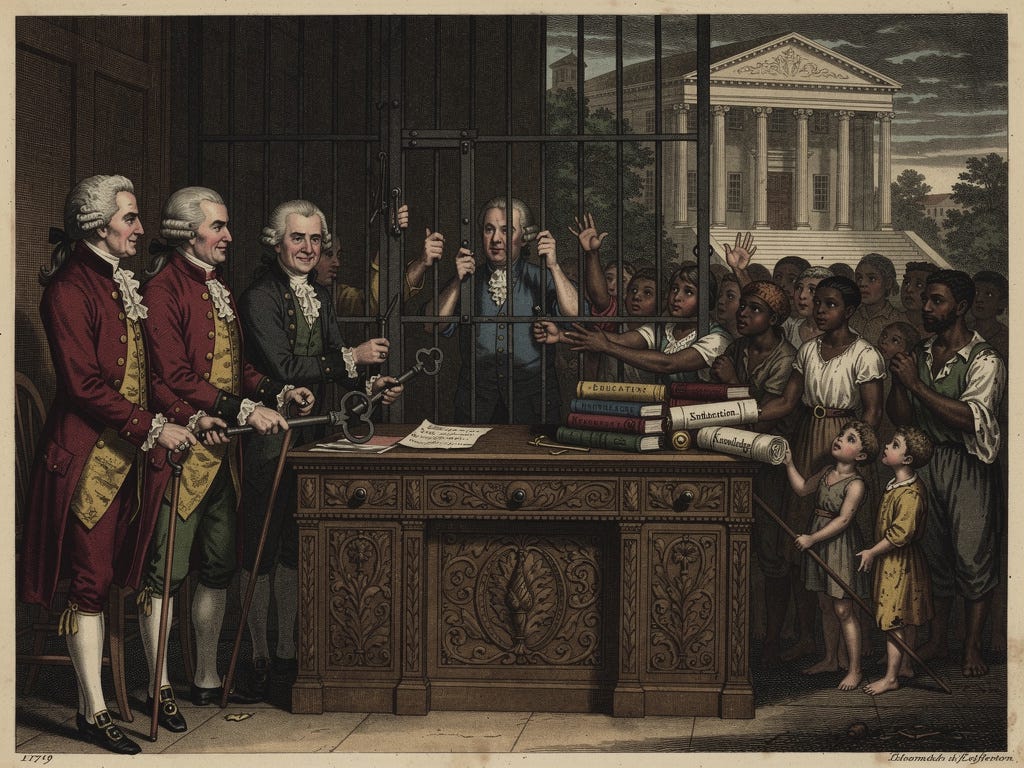
In my last blog article I explained education in America is in decline as prices rise and its helpfulness today questioned.
I explained Thomas Jefferson believed “Laws and institutions must go hand in hand with the progress of the human mind”. Jefferson insisted people be educated not just for the economy but also to ensure they were an effective checks and balances against government.
Thomas Jefferson spent many years of his life persuading the Virginia legislature to pass the bill for universal education for all white citizens—rich or poor ; men or women (unfortunately Jefferson did not believe in educational rights for African Americans).
Jefferson’s attempts failed despite help from good friends like James Madison. The wealthy amongst the Virginia legislature did not feel it should be their burden to pay for another’s education in need. This pained Thomas Jefferson bitterly. Jefferson truly believed education was not just about prosperity but also about ensuring people were responsible with it—and that includes distinguishing if rulers were responsible with their power. And Jefferson believed a lack of access to universal education would be a huge hindrance to that.
Jefferson based his educational ideals from the mistakes other nations made from his time. Jefferson visited France in his lifetime and was aware of the civil struggles that led to the French Revolution. The wealth inequality gap between the rich and the poor was atrocious. In France, unlike the US, universities served the rich and the church only. Both of these institutions suppressed Enlightment ideals—such as those of John Locke that threatened the control the church and monarchy’s control.
From the case of France we learn education can be misused to oppress and control
people when used for the wrong reason.
Britain, Spain, and the Ottoman Empires were just one of several other governments / religious institutions that used education to stay in power. All of these national governments faced rebellions for their oppression and ultimately lost power.
Jefferson’s personal battles with Britain in the United States and the civil tension he personally saw in France inspired him to invest in education: co-founding the University of Virginia and several failed attempts to convince the Virginia legislature to pass free education.
There are a bunch of sad lessons to be learnt from Jefferson’s failed—sometimes even hypocritical—attempts to “improve” education in Virginia.
After Jefferson proposed “Bill for the More General Diffusion of Knowledge” The white, wealthy of the Virginia population did not believe it was worth paying taxes to support the poor.
I will give case studies here to remind readers why tragedies like this happen throughout world history.
Even Thomas Jefferson contradicted his own ideals. He founded the University of Virginia targeting the sons of wealthy landowners, lawyers, and merchants. The University of Virginia was maintained by slaves. Worse still—the slaves were often harassed, bullied, and in extreme cases dissected after death.1
Like other slaveowners Jefferson wanted to keep their slaves illiterate to avoid spreading ideas of legally required freedom for slaves—a concept called abolition. Slavemasters hoped restricting access to education would prevent slaves from launching successful rebellions. Sadly this strategy worked—with the Haitian Slave Rebellion being the only successful slave rebellion in history.2
The citizens of Virginia were also unwilling to help poor people receive an education. Several political figures including Thomas Jefferson and John Tyler Sr failed despite their best efforts. The citizens of Virginia believed they could have a republic without paying for the next generation’s education.3 A fate that is taking place today in America through skyrocketing tuition costs. A fate that is taking place today in America through skyrocketing tuition costs. Most Virginians quit education only after a few years of schooling to work at farms or shops. 4 Saddened, Jefferson said “No other sure foundation can be devised for the preservation of freedom and happiness”5
It is ironic that Jefferson’s own people wanted democracy yet were unwilling to invest to protect it—favoring wealth attainment over protecting everyone’s rights—a common cause of downfall in history. In his work “The Republic” Plato warns the downfall of society begins when people lose power to the wealthy and those of high status—yet take no civic action to disengage this. Gradually the society depraves to an oligarchy—where only the rich rule silently as monarchs. Left unchecked a desperate people powerless in debt before the wealthy allows a tyrant to assume emergency powers—forgiving debts—and quietly executing anyone that stands in his way—assuming rule as an authoritarian.6
In Taylor’s work we read that the South falls to an oligarchy controlled by landowners enslaving a people for their own gain. To this day wealth inequality and racism remain a problem in the South. At this time US President Trump holds more popularity in Southern states than in the Northern states. The parallel to Plato’s “tyrant” and Trump is striking. In the past Trump has managed to convince supporters to riot at the State Capitol and a second time with the Iranian War—which the US Military has promised will bring the Second Coming of Jesus.78
My main point in narrating this to you is that the downfall of society begins when value wealth, honor, and status over ethics. Nations including Ancient Greece and Rome—which the United States is modeled after—have fallen for this reason—even though they predicted it! Entire nation’s economies in World War II collapsed thanks to this greed—having to rebuild their economies from scratch. The good news is that these European nations—especially Germany—have thankfully learned their lesson. By now nations in the European Union feature accessible public education that instruct both civic and economic education to prevent the horrors that took place in the war. Judging by the war, increasing wealth gap, and increased executive powers Trump is gaining—the US is headed towards the same economic collapse and the rise of tyranny.
If the wealth gap keeps getting worse unchecked, if colleges become too expensive just as education became too expensive to afford in the South, if we do not teach our youth who we should trust our lives with as leaders in civic education—we are destined to suffer the fate of the nations that collapsed in World War II.
The current situation in the US was not, on average, as bad as it is today. US public education reached its peak by the late 20th century. However starting from Ronald Reagan’s Administration this went on decline. In the next blog post I will explain how the US went from lacking public education, to education for all, and finally to the current situation where it is destined to be affordable only to the wealthy.
Taylor, Alan. Thomas Jefferson’s Education. W.W. Norton & Company, 2019, pp. 270–271.
Taylor, Alan. Thomas Jefferson’s Education. W.W. Norton & Company, 2019, pp. 151–152.
Taylor, Alan. Thomas Jefferson’s Education. W.W. Norton & Company, 2019, pp. 164–173.
The difference in the economic growth of the North and South is no accident. The North was poor in natural resources yet rich in technological innovation—fueling its economic growth. The South was rich in natural resources and relied on selling it to earn a profit—hence their dependence on slavery to reduce costs. This explains the reluctance of Southern states to invest in public education including Virginia. The victory of the North in the US Civil War is built upon this history. After the US Civil War the US Federal Government mandated free public education in the South—allowing Jefferson’s vision to become true.
Taylor, Alan. Thomas Jefferson’s Education. W.W. Norton & Company, 2019, pp. 164.
Plato. Republic. Translated by Benjamin Jowett, MIT Internet Classics Archive, 2008, classic.mit.edu/Plato/republic.9.viii.html. Accessed 1 Apr. 2026.
Kamisar, Ben. “Trump Faces Setback in Civil Suits Related to Capitol Riot.” Politico, 31 Mar. 2026, www.politico.com/news/2026/03/31/trump-setback-civil-suits-capitol-riot-00853761 (accessed 1 Apr. 2026).
Dehghan, Saeed Kamali. "US and Israel's Christian Rhetoric Fuels Fears of Wider War with Iran." The Guardian, 3 Mar. 2026, www.theguardian.com/world/2026/mar/03/us-israel-iran-war-christian-rhetoric (accessed 1 Apr. 2026).