
Hi. I am FOSRES (Free and Open Source Security Research). You may know me from my technical blog to prepare for Security Engineering interviews. You may find it unusual I am now speaking to you directly rather than allowing Claude to do the work for me.
I decided to make this blog series about teaching three things:
Teach people how to distinguish who is trustworthy with their lives. It is not sufficient to be technically excellent. You need to be socially aware of the ethical decisions people make with them.
This includes being able to detect lies, deceit, and manipulation.
This includes being able to earn the trust of the trustworthy.
It also includes being able to work productively with the trustworthy.
2. Teach people how to manage their information safely with such trustworthy people. Unlike my technical blog this blog explains how to deal with people in protecting human communication.
3. Teach people how to ethically earn a living working with such trustworthy people. From employment to business. This blog will explain how to identify people that one should look forward to working with—as well as distilling the work opportunities one should stay away from and why.
To summarize it bluntly: Influence people to make the right decision.
Train people to predict, detect, and resist lies, deceit, and manipulation.
In the real world cybersecurity leaders sometimes deal with reluctant, overconfident staff. When it comes down to setting up proper defenses—teams can hesitate due to cost concerns. Being a good cybersecurity leader does not just demand technical excellence.
It demands empathy, rhetoric, applied knowledge of how the past can help us predict the future—the social skills that are not taught at school nor work.
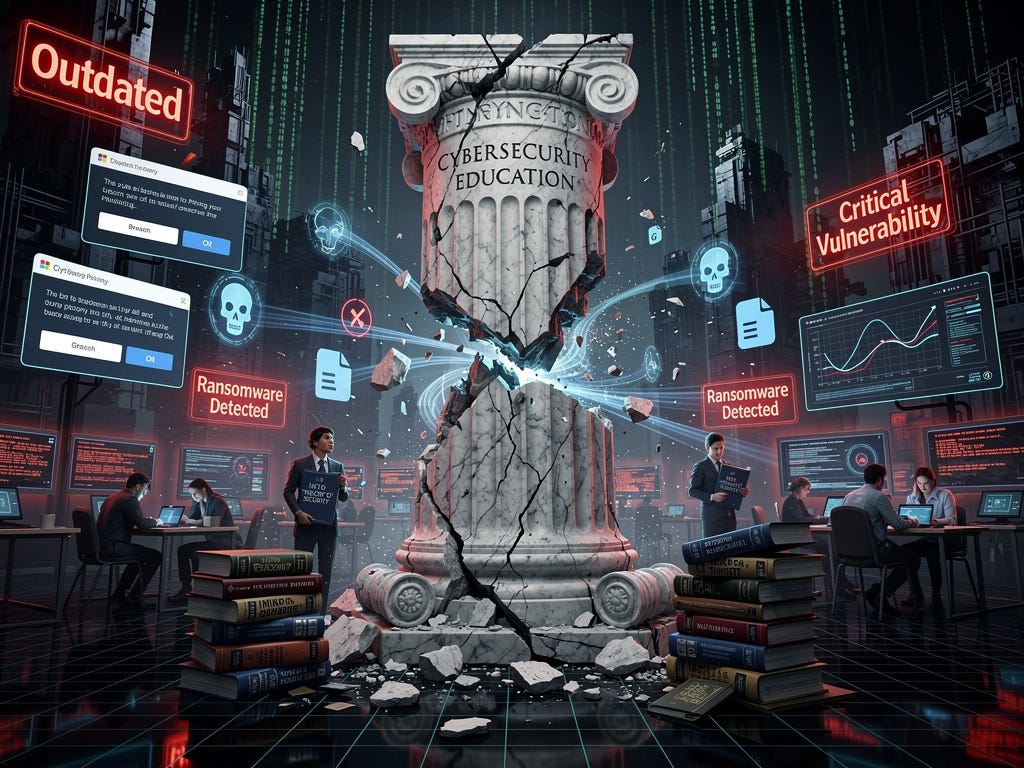
Cybersecurity professionals are admitting cybersecurity issues continue to plague the world and are getting worse. Most college programs do not educate their students on how to use technology safely—even if one is in a computer science program. Worse, College programs only are getting more expensive with time. And that is why my interest in writing about this began with a simple question I asked Claude: why is college so expensive?
The results shocked me. And led me down a historical investigation on what the original leaders of America envisioned education to be, what American education became up to its peak though not what the leaders wanted, and why it is now in sharp decline.
This blog article explains the history of accessible public education in the US starting with Thomas Jefferson. I will explain what Jefferson believed should be taught and why. I will next explain why Jefferson insisted education should be accessible to all US citizens. I will finally conclude with an explanation on why Jefferson’s principles are important for cybersecurity professionals to be aware of.
Since America’s founding the United States Federal Government believed education is a critical resource to grow the nation’s economy as much as a resource to protect the integrity of democracy. American leaders have written notes on why they believed education is crucial to sustaining democracy. One of the most well documented is Jefferson’s writings on education.
The following is a critical excerpt on why Thomas Jefferson believed this:
I am a great friend to the improvements of …schools…the literary fund is a solid provision…it would set agoing at once, and for ever maintain a system of primary or ward schools, and an university where might be taught in it’s highest degree every branch of science useful in our time & country: and it would rescue us from the tax of toryism, fanaticism, & indifferentism to their own state which we now send our youth to bring from those of New England.
…if a nation expects to be ignorant & free, in a state of civilisation, it expects what never was & never will be. the functionaries of every government have propensities to command at will the liberty & property of their constituents. there is no safe deposit for these but with the people themselves; nor can they be safe with them without information. where the press is free and every man able to read, all is safe.
— Thomas Jefferson to Charles Yancey, 6 January 1816
As we see in the excerpt Jefferson believed a literate, informed society with access to a press that allows them to speak their minds would ensure society was resistant to people that would hoard power for themselves (toryism), a government biased towards a religion (fanaticism), or a lack of care on how their lives were governed.
Here is a summary of the subjects Jefferson deemed indispensable for democracy that I deem relevant today (so not all of the subjects Jefferson recommended are listed here due to lack of relevance today):
Reading and Writing: Like many Jefferson believed literacy was important to allow a person to make independent decisions as a free, responsible human being. A skill that would be useful, though alone insufficient, in business, finance, and legality. Everyone can agree with his reasoning. Without literacy a person will forget critical details and their analysis will be weaker.
Here is a direct quote by Jefferson on literacy’s importance:
“To give to every citizen the information he needs for the transaction of his own business. To enable him to calculate for himself, and to express and preserve his ideas, his contracts and accounts in writing. To understand his duties to his neighbors and country, and to discharge with competence the functions confided to him by either. To know his rights.” — Jefferson from “Report for University of Virginia (1818)”
Classical Works on Government, Law, Politics, and Rhetoric from Ancient Greece and Rome
I admit Thomas Jefferson insisted every American citizen be trained in Classical Greek and Roman—not just read the translations of great Classical Works such as “Politics” by Aristotle. Jefferson believed learning Classics would build one’s reasoning skills. Here is a direct quote from Jefferson:
“I think the Greeks and Romans have left us the present models which exist of fine composition, whether we examine them as works of reason, or of style and fancy; and to them we probably owe these characteristics of modern composition. I know of no composition of any other people, which merits the least regard as a model for its matter or style.” — Jefferson from “From a Letter of Thomas Jefferson to Dr. Joseph Priestly (English Chemist)”
I would disagree with Thomas Jefferson here. Today, almost no members of European Union government are formally trained in Classics! Starting from the 19th century in Europe there was a movement to phase out training in Classics in favor of training students in modern sciences and technology. One of the most important legal bills protecting privacy in the European Union, the Global Domestic Privacy Regulation, was written by lawmakers with no documented formal training in classics for this reason! Today if you were to walk into any security conference you will find people openly discussing the importance of GDPR as an authentic and effective lawcode to protect the privacy of consumers in online e-commerce—even from Americans themselves! GDPR is one of the strongest and most respected legal bills protecting online privacy in the world—if not the most reputed.
And with saying although I see a lack of evidence that learning the Classical Languages themselves is important studying the Classical works in translation still are!
In the United States (American students that take more humanities and social science courses read Classical works (in translation!)—and engage more in civic discourse thanks to the critical thinking skills they gain from them.
Specifically, students with more social science and humanities or arts courses show higher levels of civic engagement, suggesting that these fields are strong contributors to higher education’s civic mission. — SAGE
I conclude with saying that studying translations of Classical works will make any person more informed when engaging in civic discourse with others—it has a proven history that goes as far back as Ancient Greece—through America’s founding—and even as late as the Civil Rights Movement!
Notable figures including Adams, Madison, Jefferson, Abraham Lincoln, Martin Luther King Jr, and W.E.B. Du Bois all were familiar with Classical works and drew inspiration from them in their activism.
Thomas Jefferson’s writings and our nation’s reliance on Classical Works in legality nad politics made me interested in reading them. People that had an impact on US politics and government were familiar with the classic works of Greece and Rome. And every cybersecurity professional must be familiar with how laws and government affect how cybersecurity is practiced. They must be able to engage in civic discourse on how privacy should be respected. They must observe the words and actions of political figures and analyze how they affect how we protect this important civil right.
Politics, business, and economics affect the practice of cybersecurity as they do in every field. The aforementioned works will help one analyze how politics plays a role.
There are many important works from Ancient Greece and Rome that have influenced democracies including—but not limited to—Aristotle’s “Politics”, Plato’s “Republic”, and Cicero’s books on Rhetoric. Since these works have played a role in democratic governments around the world I am convinced such works are must-reads.
Without education in politics one cannot determine if the people that run these institutions are trustworthy. From politics we learn how to distill an organization’s true interests from the mere claims we hear. Without rhetoric security professionals will struggle to persuade staff to setup critical security defenses—especially when those defenses often are costly! Rhetoric also gives one the skill in detecting lies, deceit, and manipulation. Cybersecurity is no stranger to the effects of propaganda, fads, and foul ideas that amass huge profits in the marketplace! Detecting these issues and addressing them with people face-to-face are the skills a cybersecurity leader must have!
With saying I hope my introduction to Jefferson’s emphasis on Classical Works has now sparked your interest in reading them. They expand one’s skill in persuasaion as much as build one’s resistance to deception—an essential complement to one’s technical skills in the workforce.
Critical Resource: https://founders.archives.gov/documents/Madison/04-01-02-0289
Mathematics: Thomas Jefferson not only believed mathematics was important for commerce but also to teach people to spot fraud. It is a pity modern schools do not teach people to detect fraud when interpreting financial statements.
Here is an essential quote by Jefferson on why basic math is so important:
To harmonize & promote the interests of agriculture, manufactures & commerce and by well informed views of political economy to give a free scope to the public industry — Jefferson from “Report of the Board of Commissioners for the University of Virginia”
Jefferson was arguing above that without basic arithmetic people would not be able to tell if the government was managing the economy responsibly. Its a shame political economics is not taught in schools. Even cybersecurity professionals should pay attention to political economy. The government affects the cybersecurity industry—and I will write more blogs in the future on how that happened later. As a brief reminder tax dollars cover important programs such as the National Institute of Standards and Technology—which publishes industry-recognized standards for digital security to this day. Without that international ecommerce would never exist as we know it today.
Throughout history people have been able to keep corruption in check thanks to literacy. Following the invention of the printing press a literate people in England were able to deduce that it was best to permit freedom of the press for the sake of economic growth as well as speaking out against someone’s mistreatment. A literate American people decided to allow unrestricted use of the Telegraph—a necessary strategy to win the US Civil War and to grow the US economy afterwards—as well allow the press to spread uncensored news. A literate people read Ida B Tarbell’s “The History of the Standard Oil Company”. An enraged American people decided to pass The Sherman Antitrust Act—a law banning monopolies to allow free competition.
Today these problems have taken new forms. Where social media and data companies in the Tech industry are deemed a threat to our freedom of speech and thought. These same companies are now being called out for restricting our freedom of choice—even being compared to the tyranny of empires.
Just as people applied their skills in literacy and arithmetic in the historical cases we mentioned so too must we apply these skills to determine how these companies should manage our lives. And to do that laws must be written and checked.
Law
Thomas Jefferson believed citizens should be educated enough to determine for themselves if laws protected their civil rights—not merely rely on the Judicial Branch to verify for them:
To expound the principles & structure of government, the laws which regulate the intercourse of nations, those formed municipally for our own government, and a sound spirit of legislation, which banishing all arbitrary & unnecessary restraint on individual action shall leave us free to do whatever does not violate the equal rights of another. — Jefferson from “Report of the Board of Commissioners for the University of Virginia to the Virginia General Assembly, [4 August] 1818”
Citizens must take an active part in legality in order for the law to remain just—that is what Jefferson believed.
US Congress has passed legal bills regulating how people must manage others’ lives with computers since the Banking Privacy Act of 1974. Since 1974 to modern times businesses, nonprofit organizations such as the Electronic Frontier Foundation, and computer security professionals like Bruce Schneier have all argued how our lives should be managed by others when using digital machine. During the time between 1974 to the present there have been several critical debates on whether the US government truly cares to protect our civil rights—with the most controversial incident being Edward Snowden’s leakage of NSA Classified documents—revealing the US Federal Government has spied on the Internet activity of its own citizens since the passing of the Patriot Act following 9/11.
As a security professional you should be making a decision on whether the laws the US Government pass protect our liberties—or are secret strategies to take them away from us. Just recently the US Department of Defense decided to weaponize OpenAI’s technology for the first time. Many American decided to switch to competitor Claude in response. Do you think that’s the right move?
Here is a critical resource on Jefferson’s views on Education. In it he stresses the importance of people applying their history knowledge to prevent corruption (Notes on the State of Virginia).
As I said earlier the US Federal Government has abused its powers to spy on its citizens several times in the past without their consent—arguably a violation of the Fourth Amendment. The US has even hid its surveillance activities from the public and has also lied about its surveillance activities before being caught.
Since 2018 the US has passed the CLOUD Act which requires all US Tech companies to hand over user data to the US Federal Government at any time.
“A provider of electronic communication service or remote computing service shall comply with the obligations of this chapter to preserve, backup, or disclose the contents of a wire or electronic communication and any record or other information pertaining to a customer or subscriber within such provider’s possession, custody, or control, regardless of whether such communication, record, or other information is located within or outside of the United States.” — CLOUD Act Section 3 2713
NOTE: Although the last part of the excerpt requires US companies to reveal information stored outside of the US only tech companies based in the US are required to comply.
Legal bills such as the above are complex and in depth. Yet they are used in political discussions everywhere. Naturally the actual interpretations and even words of the CLOUD Act are sometimes perverted—an unfortunate side effect that takes place whenever political conflict takes place.
In future blog articles I will explain in detail how this happened and how this ties to historical events. This is becoming an even more major concern since the US Department of Defense began using AI as a military weapon. One of the first public concerns was mass surveillance and although OpenAI established a policy with the Department of Defense to not spy on citizens—the US Federal Government’s past actions makes that hard to believe.
Geography
Although no official writing by Jefferson explains why he believed it to be essential Geography was taught in Jefferson’s time—not to memorize the names of places on the Earth—but to teach people how physical limits affect a nation’s power. Even in modern times geography affects cybersecurity. Different countries have different laws governing how a person’s data must be managed. Countries that are part of The Five Eyes are infamous for spying on each other’s citizens!
I already earlier mentioned the European Union is well known for the Global Domestic Privacy Regulation. So if you use a privacy service from a EU country you are not subject to US Laws and Customs as said service is not hosted on US territory. This matters when you realize ICE has been authorized to spy on people’s phones—just as the NSA was allowed to before the Snowden Leaks. By now ICE has deported over 396,400 people. This is what the Anti-Federalists feared—unreasonable search and seizures. And because of the debates between Federalists and Anti-Federalists the Fourth Amendment was ratified.
History
Jefferson argued we should not only be aware of historical events as we learn today—but we must learn to recognize patterns in corruption in organizations:
History by apprising them of the past will enable them to judge of the future; it will avail them of the experience of other times and other nations; it will qualify them as judges of the actions and designs of men; it will enable them to know ambition under every disguise it may assume; and knowing it, to defeat its views. In every government on earth is some trace of human weakness, some germ of corruption and degeneracy, which cunning will discover, and wickedness insensibly open, cultivate, and improve. Every government degenerates when trusted to the rulers of the people alone. The people themselves therefore are its only safe depositories. — Jefferson from “Notes on the State of Virginia: Query 14”
Cybersecurity professionals must predict what a leader’s true motives are and predict future outcomes—which always have a similarity to past actions. This will prepare cybersecurity professionals to handle political situations that affect the honest practice of cybersecurity. History is thus a complement to rhetoric—which was partially taught to teach people how to spot deception.
At work you as a security professional will be forced to deal with political decisions being made behind the scenes—even though your employer commands you to not discuss politics—you still have to be mindful of how it affects everyone’s work lifestyle. You will see people being treated unfairly—you will be treated unfairly at some point! You will see people forsake ethics for power, money, and status—the exact things Plato warned were the downfall of a democracy to an oligarchy—the final step before the rise of tyranny. A great book that teaches one to spot these problems is Robert Greene’s The 48 Laws of Power—a book every young person should read right before they begin their college education. College is every person’s first introduction to the corporate world—and Greene’s books apply there as in any other field in the workforce. I daresay Greene’s books are closer to the history Jefferson wanted people to be taught—but never were.
Unfortunately Robert Greene’s only explain how the powerful stay in power. Whereas Jefferson insisted we need to be taught how to resist oppression:
Whereas it appeareth that however certain forms of government are better calculated than others to protect individuals in the free exercise of their natural rights…yet experience hath shewn, that even under the best forms, those entrusted with power have, in time, and by slow operations, perverted it into tyranny; and it is believed that the most effectual means of preventing this would be, to illuminate, as far as practicable, the minds of the people at large, and more especially to give them knowledge of those facts, which history exhibiteth, that, possessed thereby of the experience of other ages and countries, they may be enabled to know ambition under all its shapes, and prompt to exert their natural powers to defeat its purposes…— Thomas Jefferson from “A Bill for the More General Diffusion of Knowledge, 18 June 1779”
Conclusion
I began this blog with a complaint that cybersecurity education was in a state of decline. For this blog I only touched on what Jefferson believed education should be—a means to enrich America and even moreso an essential defense against corruption.
I am sorry to tell you the second half of Jefferson’s vision of education has mostly been ignored in the public education system. The next blog series will briefly touch Jefferson’s fight for accessible education. A fight he lost in own lifetime.